Your infrastructure
Install a Kubernetes platform on suitable Linux servers, with infrastructure you choose and control.

Kipper brings Kubernetes installation, a web console and application deployment together on infrastructure you choose. We built it to make the platform easier to work with.
Built and maintained by Labb Consulting. Used across our own projects.
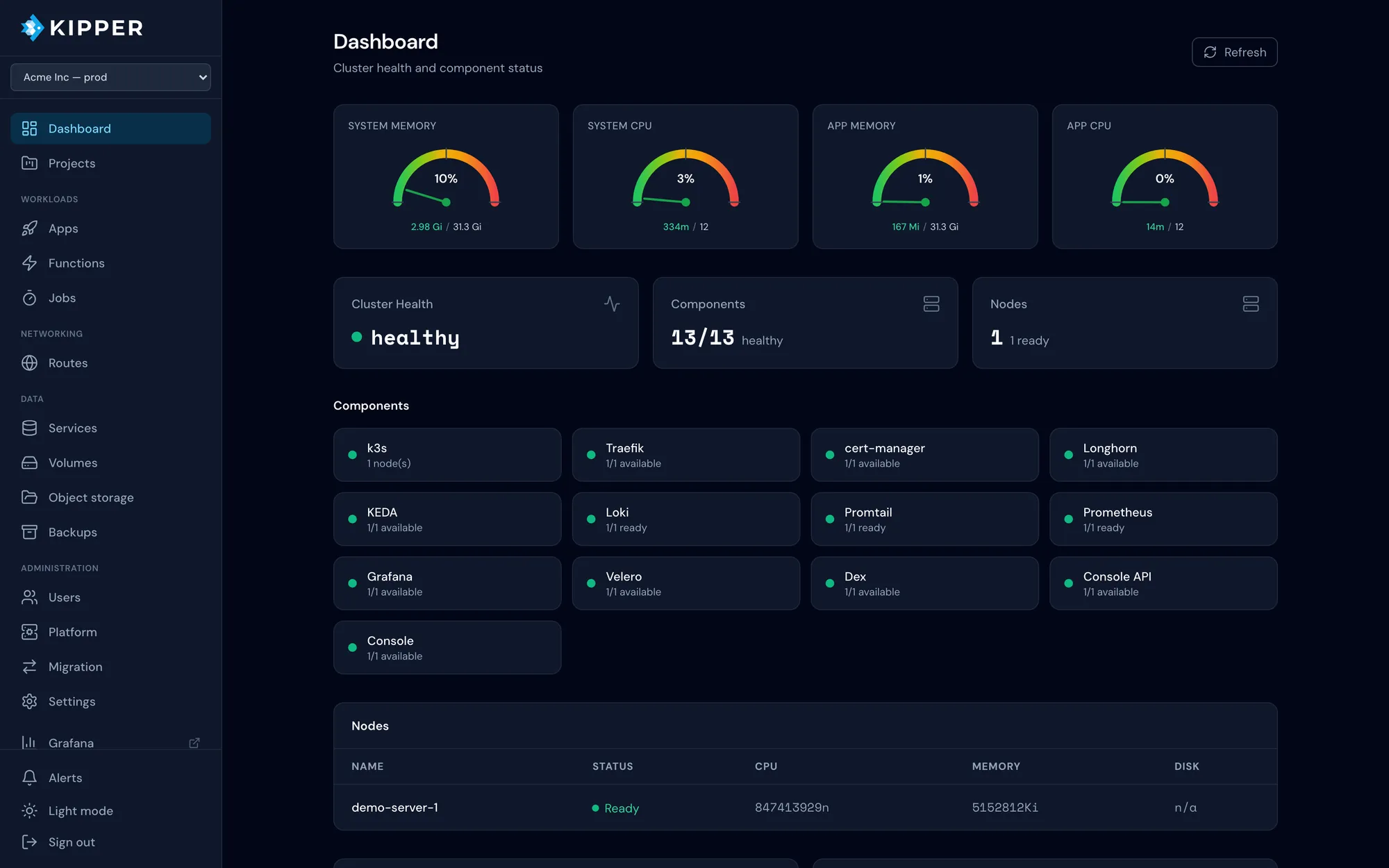
We have spent a long time building Kipper. Today, almost everything we run is on it. Our latest project migration is complete, and we use the same platform we help others adopt.
The remaining workloads need multi-node setups. They stay on their current platforms until Kipper supports what they need.
Install the CLI, prepare a server and deploy an application. This scripted example shows the starting point; server access, configuration and operational requirements are part of the setup.
$ curl -sL https://getkipper.com/install | sh
✓ kip installed
$ kip install --host 203.0.113.10 --ssh-key ~/.ssh/id_ed25519
✓ cluster ready  https://c-7f2a.kipper.run
$ kip app deploy --name shop --image ghcr.io/acme/shop:1.4
✓ shop is live  https://shop.c-7f2a.kipper.run
Kipper brings the work around an application into one place, with a CLI for delivery and a console for visibility.
Install a Kubernetes platform on suitable Linux servers, with infrastructure you choose and control.
Deploy your applications through the CLI and manage them in the same platform.
See applications, cluster health and platform components together, instead of piecing together separate views.
Work with application logs, services and backups as part of the platform.
Read the code, follow development and use Kipper under the Apache 2.0 license.
Work with the engineers developing and using Kipper to assess fit, plan a migration and support your setup.
Kipper already hosts nearly all of our projects. Running it ourselves keeps development close to the practical work of deploying and maintaining applications.
Support for multi-node setups is planned. It is the next step for the applications and client environments that we have not yet moved. Our intention is to migrate those too, once their requirements are supported.
Multi-node support is not available yet. For workloads that require it today, we can help with an existing Kubernetes platform.
Yes. Almost everything we run is now on Kipper, including our latest project migration. The remaining workloads need multi-node setups, which are on the roadmap.
Not yet. Multi-node support is planned. We will assess your current requirements rather than base a deployment on a future feature.
Yes. We can assess the workload, its data and dependencies, and plan the installation, migration and ongoing operation.
No. We also work with managed cloud Kubernetes and existing platforms without Kipper.
The Kipper website, documentation and public GitHub repository describe the current release, installation requirements and limitations. Kipper is open source under Apache 2.0.
A new product, a platform that needs attention, or an AI idea worth exploring. Let's talk it through.